The Art of the Underwater World: What Cozumel’s Reefs Teach Us About Color, Form, and Design
Introduction: A Living Canvas Below the Surface
Every art student learns about color theory in a classroom. You study Itten’s color wheel, the relationships between complementary hues, the way warm and cool tones create visual tension or harmony. You analyze how Matisse used saturated color to generate emotional energy, how Mondrian stripped composition to its purest structural elements, how the Impressionists chased the way light changes the perceived quality of color across a single afternoon.
None of that preparation quite equips you for the moment you put your face underwater in Cozumel.
The Mesoamerican Barrier Reef, of which Cozumel’s western shore is the most spectacular accessible section, is the second-largest coral reef system on the planet. It stretches more than 1,000 kilometers and contains more species of coral, fish, and marine life than most terrestrial ecosystems can accommodate in twice the area. From an art and design standpoint, it is also one of the most visually complex, formally sophisticated, and chromatically strange environments that exists anywhere on Earth. The design principles operating beneath the surface — in the architecture of coral, the camouflage of marine creatures, the movement of light through water — are not incidental. They are some of the oldest and most refined visual solutions to a set of problems that natural selection has been working on for hundreds of millions of years.
This article explores what the underwater environment of Cozumel offers to designers, artists, and anyone interested in visual creativity — and why the experience of snorkeling a reef is, among other things, one of the most concentrated encounters with applied design principles that the natural world provides.
Color Theory at Depth: What Happens to Light Underwater
The first thing water does to light is edit it. Selectively, dramatically, and in ways that produce color environments that paint cannot easily replicate.
Seawater absorbs light wavelengths at different rates depending on depth. Red wavelengths, with their longer wave cycles, are absorbed within the first few meters of water. Orange follows at around 5 meters. Yellow diminishes by 10. By 15 to 20 meters of depth, the dominant visible wavelengths are blue and green, because those shorter-wave colors penetrate furthest through water before being absorbed.
The practical visual effect is that underwater color relationships shift dramatically with depth. A bright red fish — the flame hawkfish, common on Caribbean reefs — appears red only near the surface where red wavelengths still reach it. At 5 meters, that same fish begins to appear orange-brown. At 15 meters, it reads as almost black, its vivid coloration invisible without artificial light. This is one of the reasons underwater photographers use flash even in bright tropical conditions — not for exposure, but to restore the color that water has removed.
For students of color theory, this is not an academic footnote. It is a real-time demonstration of how the transmission medium alters color perception independently of the object’s actual surface properties. The fish has not changed. Its pigment is identical. Only the light reaching it has changed. The same principle underlies the experience of viewing paintings under different lighting conditions, the importance of color rendering index in gallery lighting design, and the reason that digital artwork calibrated on a screen can look completely different when printed.
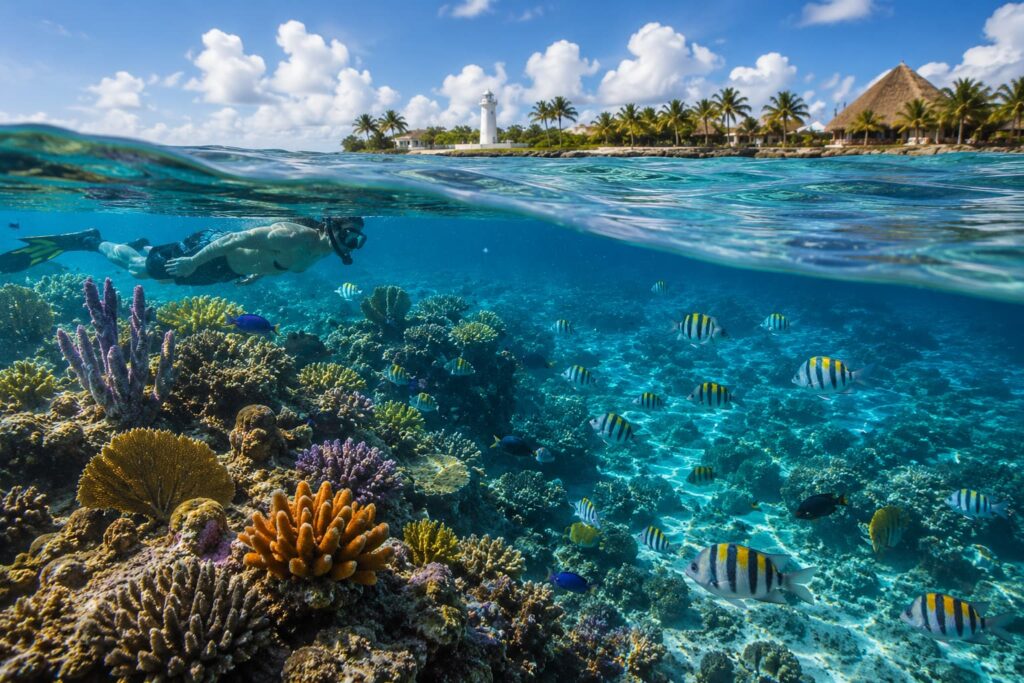
In the shallow snorkeling waters around Cozumel — typically 3 to 15 meters deep — this color absorption effect is partially in play. At El Cielo, the famous starfish lagoon that appears on virtually every Cozumel tour itinerary, the water is so shallow (waist-depth at parts of the sandbar) that the full visible spectrum reaches the bottom. The result is a chromatically complete environment: starfish in their natural orange-red, the white sand floor reflecting the sky above, the turquoise of the water column adding its own dominant hue over everything. The color palette at El Cielo, when experienced directly through a snorkel mask, is something close to the saturated, high-contrast visual world that graphic designers work within in a screen environment — every element at full saturation, nothing grayed out by distance or depth.
Palancar and Colombia Reefs, accessible by boat tour through Cozumel Snorkeling Tours, operate at greater depth — the tops of the reef structures typically run 6 to 12 meters below the surface, with the wall formations dropping much further. At this depth, the color shift is perceptible: the reds and oranges in the coral soften, the blues intensify, and the visual environment takes on the characteristic shifted palette that painters like Winslow Homer and Paul Signac captured in their marine work, that quality of everything slightly cooled and deepened that the eye reads as aquatic rather than terrestrial.
Coral Architecture: Form, Structure, and Designed Purpose
If color theory is what the reef teaches students of painting, its structural forms teach something closer to what architecture and 3D design students work with.
Coral reefs are not decorative. Every structural element of coral growth is a functional solution to a set of biological problems: maximizing surface area for photosynthetic zooxanthellae, creating shelter from predators, anchoring against current without snapping, distributing growth toward light. The forms that result from these constraints are not random. They are optimized, and the optimization produces structures that art and design history has reached toward repeatedly without always achieving.
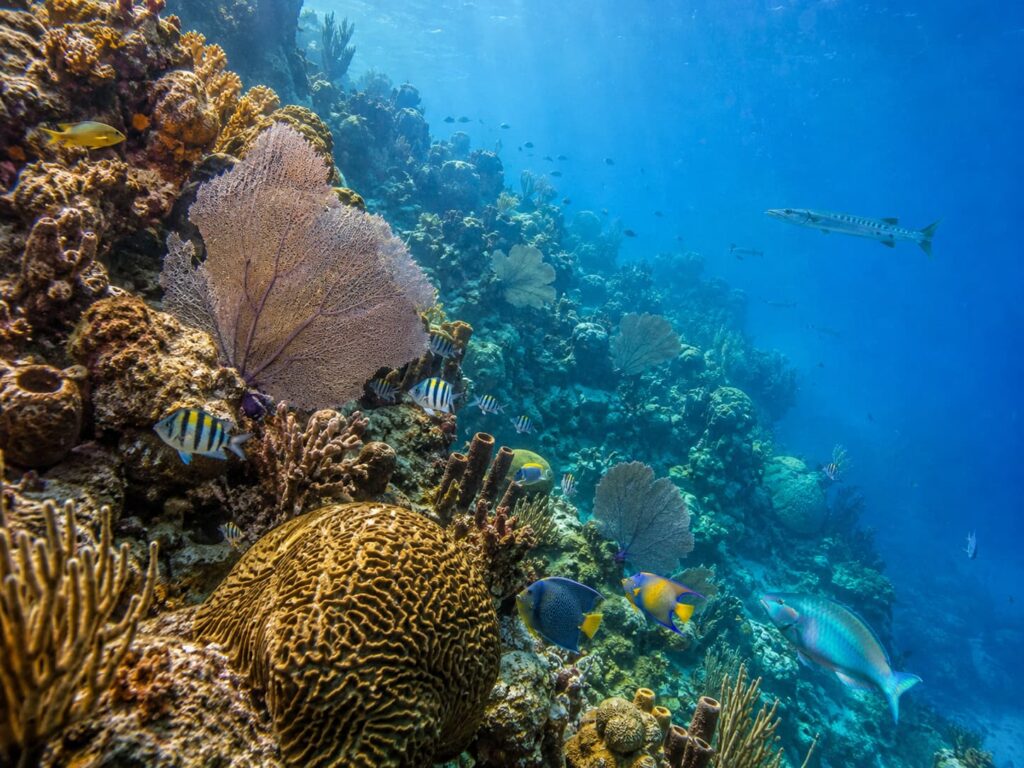
Brain coral (Diploria labyrinthiformis) grows in near-perfect spherical masses covered in a continuous labyrinthine groove pattern — a form that combines the structural efficiency of a sphere (maximum volume per unit of surface) with the surface articulation of a maze that maximizes contact area for symbiotic algae. The groove pattern is not uniform across the entire sphere; it adapts to the local conditions of growth, curving and branching in response to light direction and water flow. Students of 3D design and modelmaking will recognize the form immediately as one they have been asked to generate procedurally in software — a surface that varies according to environmental parameters while maintaining coherent structural logic.
Staghorn coral (Acropora cervicornis) grows in branching columns that resemble both antler structures and certain modernist architectural studies of branching load distribution. Each branch forks at irregular but statistically predictable angles, with the branching frequency increasing toward the tips where growth is fastest. The visual effect of a large staghorn coral colony in healthy water is of a three-dimensional drawing — a sculpture made of lines rather than mass, the space between the branches as visually significant as the branches themselves.
Sea fans (Gorgonia species) grow in flattened vertical planes perpendicular to current flow, with a mesh of interconnected branches that filter plankton from the passing water. The structure is a living net, and the visual pattern it produces — a branching lattice held in a single plane — is one of the most compositionally elegant forms in the marine environment. Graphic designers working with negative space will find something directly useful in studying how a sea fan distributes its structural elements across a plane: the relationship between filled and unfilled areas, the way the mesh density varies from the central axis outward, the visual rhythm of the branch intervals.
The Palancar and Colombia reef walls visible on guided Cozumel snorkeling tours display all of these structural forms simultaneously, at scales ranging from a few centimeters to several meters. The visual complexity of a healthy reef wall, experienced at close range, is more than most art students encounter in any single environmental study session.
Marine Camouflage: The Design of Disappearance
Camouflage is one of the oldest design problems — how to make a visible object appear invisible within a specific visual context. Military design has studied it extensively. Stage and costume design applies it. Digital concealment in user interface design borrows from it.
Marine life has been solving this problem for longer than any human designer, and the solutions on a Cozumel reef represent an extraordinary catalog of applied concealment strategies.
Countershading — dark pigmentation on the dorsal (upper) surface, lighter on the ventral (lower) surface — is the baseline strategy for many open-water fish. Viewed from above against the darker deep water, the dark back is difficult to distinguish. Viewed from below against the lighter sky through the surface, the pale belly blends in. Barracuda, which are regular sightings on Cozumel reef tours, use countershading with particular effectiveness; their silver bodies catch available light from multiple angles and return it in a way that constantly suggests they are part of the water column rather than a distinct object within it.
Disruptive coloration breaks up the visual outline of an animal rather than trying to match the background. The angelfish common on Caribbean reefs use this strategy: bold contrasting stripes and patterns that read as visually complex at close range but break the fish’s silhouette at distance, making it harder to identify as prey-shaped. This is the same principle underlying certain military vehicle camouflage designs that were studied by Picasso and his contemporaries in Cubism — the deliberate fragmentation of a recognizable form into competing visual elements.
Cryptic mimicry takes camouflage further into the territory of active deception. The frogfish, occasionally spotted on Cozumel’s reef structures, has evolved a body surface that mimics sponge texture and coloration with enough accuracy that even other fish fail to identify it as an animal until it strikes. The mimicry is not just visual — the frogfish sways slightly with current, behaving like a sessile object, adding behavioral deception to visual deception. From a design standpoint, this is the difference between making something look like something else and making something perform like something else.
The study of marine camouflage offers art students a catalog of strategies for manipulating visual perception that no textbook assembles in one place. Experiencing these strategies in their natural context — floating over a reef, looking for the octopus that the guide has spotted but that you cannot locate despite staring directly at it — is a visceral design education that a classroom cannot replicate.
Bioluminescence and Light Generation: When the Canvas Makes Its Own Light
Night snorkeling in Cozumel produces an encounter with one of the most unusual visual phenomena in the natural world: bioluminescence. Marine organisms capable of producing their own light — through biochemical reactions involving luciferin and luciferase — are common in ocean environments, and in Cozumel’s warm, shallow reef water, they are accessible to snorkelers without specialized equipment.
The visual quality of bioluminescent light is unlike any other light source that a designer typically works with. It is cold — blue-green in the wavelengths that most marine bioluminescence produces — and it is self-contained, appearing and extinguishing in response to disturbance, movement, or predator-prey dynamics rather than following a predictable on-off pattern. Moving a hand through water rich in bioluminescent plankton produces a trail of cold light that persists for a second or two before fading, a dynamic drawing that the body makes in the water.
For students working in animation or digital design, bioluminescence demonstrates a form of light behavior that procedural animation systems attempt to simulate: organic, responsive, non-uniform emission that carries information about the environment that generated it. The visual quality of bioluminescent light has influenced a significant body of film and game visual effects work, from the underwater sequences in Avatar to the fantasy environments of numerous video game titles that sought to capture the quality of light that appears to originate from within rather than from above.
Cozumel night snorkeling tours — a specialty experience available through Cozumel Snorkeling Tours — specifically focus on nocturnal marine life including bioluminescent organisms, octopus, squid, and the creatures that emerge after dark on the reef. Guides use underwater lights to locate and identify nocturnal species, and the contrast between the bright beam of a dive light and the surrounding biological light emission is itself a study in the interaction of artificial and natural light sources — a dynamic that photographers and cinematographers working with mixed lighting will find instructive.
Color Communication in Marine Life: The Visual Language of the Reef
Perhaps the most directly relevant design subject that the reef offers art students is color communication — the use of color as information, warning, invitation, or signal.
Marine organisms use color for communication at a level of sophistication that rivals anything in human visual design. The specific functions mapped onto specific colors in the marine environment follow rules as consistent as any design system, and studying them reveals how deeply certain color associations are embedded in visual processing across species.
Warning coloration (aposematism) — the use of vivid, high-contrast color combinations to signal toxicity or danger to potential predators — is one of the clearest examples of color functioning as a communication system rather than decoration. The bright yellow-and-black pattern of a spotted trunkfish, the vivid blue rings of the blue-ringed octopus, the orange-and-white of the clownfish (whose coloration signals its protected status within anemone tentacles) all use color to transmit specific, accurate information to viewers capable of reading the signal. Design students will recognize this as the logic of warning labels, hazard signage, and interface alerts — a color convention so consistently applied that the signal becomes readable across contexts.
Sexual signaling uses color to communicate fitness, health, and genetic quality. Male parrotfish, which are abundant on Cozumel’s reefs, are spectacularly colored — turquoise, green, pink, and yellow in combinations that have no camouflage value and significant metabolic cost to maintain. The vivid coloration signals to females that the male is healthy enough to allocate metabolic resources to non-functional display. This is the design logic of luxury goods, editorial design, and brand identity work where visual extravagance signals quality rather than concealing it — color as evidence of capacity.
Transparency as a visual strategy is demonstrated by several Caribbean species that have evolved near-complete optical transparency, allowing the reef environment behind them to be visible through their bodies. The glassfish that form dense schools in certain reef cavities are visible primarily as a shimmer of movement, their individual forms nearly impossible to distinguish from the water column. The transparent body boat tours available in Cozumel — including the Invisible Boat Snorkeling Adventure and the various glass-bottom formats listed on Cozumel Snorkeling Tours — extend this design principle to the human experience: viewing the reef through a transparent surface that allows the underwater world to be present without the visual barrier of a conventional hull. The design of the transparent boat is, in this sense, a human application of the same visual strategy that evolution discovered in reef fish.
What Reef Study Offers the Working Artist and Designer
The reef environment does not replace the studio or the classroom. It offers something complementary: an encounter with visual solutions that have been refined over evolutionary timescales without reference to human aesthetic preferences, operating across physical scales from the microscopic to the architectural, and available for direct observation by anyone willing to put a mask in the water.
Art schools teach design principles through exemplary human artifacts — canonical works, historical precedents, the analysis of successful commercial and fine art. The reef offers a completely separate body of exemplary work, one that solves the same underlying problems (how to use color, form, pattern, light, and camouflage) through entirely different means and toward entirely different ends.
The interaction between these two bodies of knowledge — human design tradition and evolved visual design — has been productive throughout art history. It animated the Art Nouveau movement’s use of organic, marine-derived forms in architectural ornamentation. It drove the Surrealist fascination with the uncanny formlessness of deep-sea creatures. It informs contemporary biomimicry research in product design and materials science. It shapes the visual imagination of every 3D modeler who has ever looked at coral and thought about how to generate procedurally irregular geometry.
The practical access point for this study in Cozumel is a snorkeling tour at one of the reef sites that the Mesoamerican Barrier Reef system provides along the island’s western shore. A four-hour tour covers multiple sites — deep reef walls, shallow sandy lagoons, turtle encounter zones — and exposes observers to the range of visual environments that the reef encompasses. The most accessible starting point for a first visit is the 3 Reefs Cozumel Boat Tour, which covers Palancar, Colombia, and El Cielo in a single morning and is the most-booked tour on the platform with over 8,000 documented departures. Specialty experiences — including the night snorkeling tour that focuses specifically on bioluminescence and nocturnal visual phenomena — are available for observers with specific interests in the light and camouflage dimensions of reef visual design.
The Smithsonian Ocean Portal maintains ongoing educational resources on reef ecology, including the color biology of marine organisms, that are directly relevant to the design study framing covered in this article.
Conclusion: The Reef as the World’s Longest-Running Design Studio
Every design studio has a body of work it draws from. The reef is a design studio that has been operating continuously for approximately 500 million years, producing solutions to visual problems with a rigor and refinement that no human institution has matched in its entire history.
The Cozumel reef offers direct access to this body of work to anyone with a snorkel mask and a few hours of free time. What you encounter there — the color relationships between tropical fish and their coral backgrounds, the structural elegance of a sea fan, the disappearing act of an octopus, the bioluminescent light in dark water — is not merely beautiful. It is instructive, in the specific sense that great design work is always instructive: it shows solutions that are better than what you would have thought of yourself.
For art and design students, the underwater world is not a vacation from the studio. It is a field visit to one of the most productive, sophisticated, and visually extraordinary design environments on the planet.
[For more on art, design, visual creativity, and the principles that underlie great artistic work, explore the courses and articles on this site.]
About the author: Written by an art educator and visual culture writer with interests in biomimicry, environmental design, and the relationship between natural systems and human creative practice.